

Every Diwali, my kitchen turns into a small factory. Murukku in one corner, sweets cooling in another, and someone always sneaking a ribbon pakoda before it reaches the dabba.
These photos are more than 10 years old. I took them with a regular camera, long before smartphones, and these are still the recipes I make every year. Nothing fancy. Just the traditional way, the way I learned it.
Here are all of them in one place: ribbon pakoda, murukku, gulab jamun, badusha, Mysore pak, date and cashew sweet, suzhiyam, ma ladoo, athirasam and lehiyam. Pick the ones you want to try this Diwali.
Happy Diwali to you and your family. 🪔
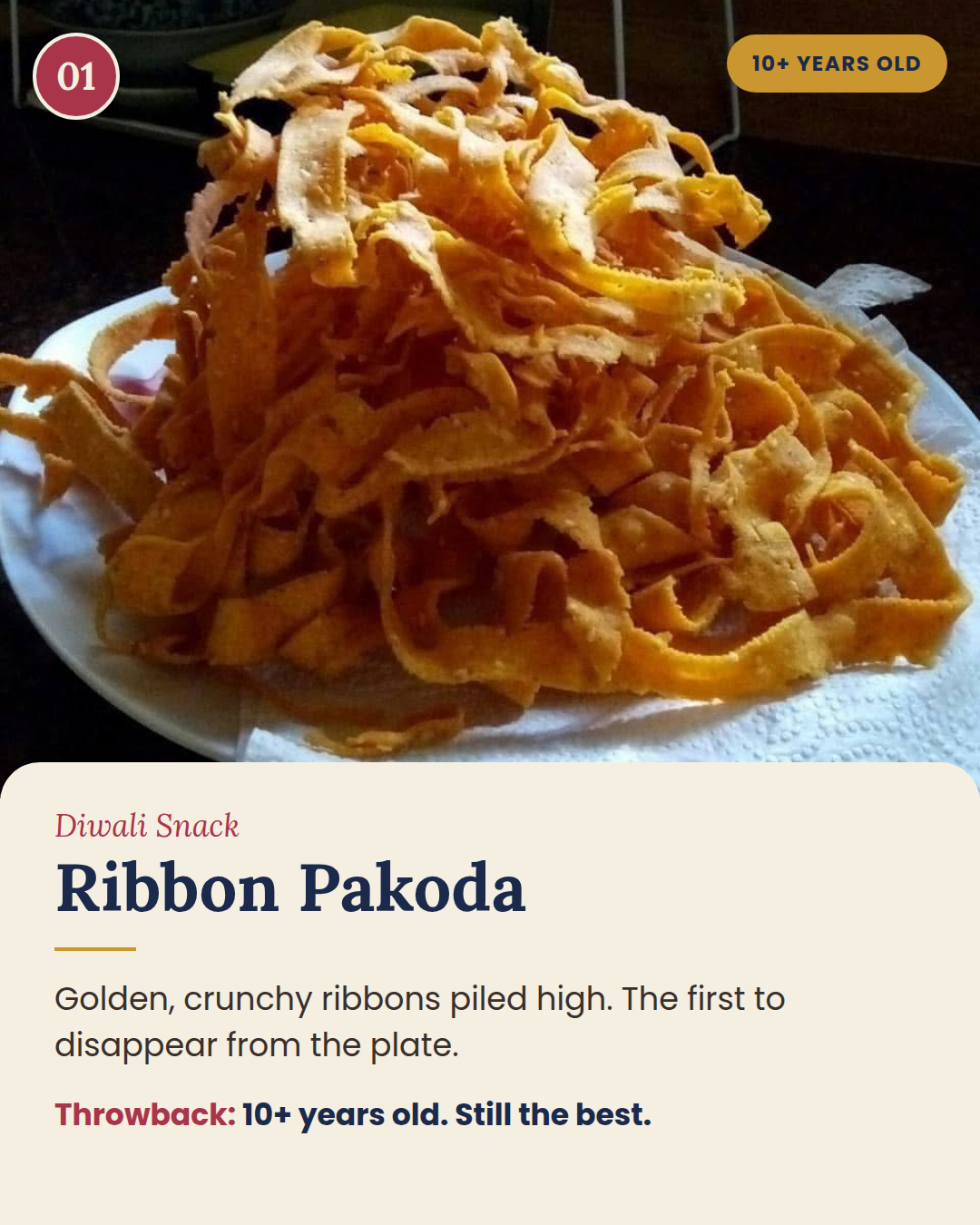
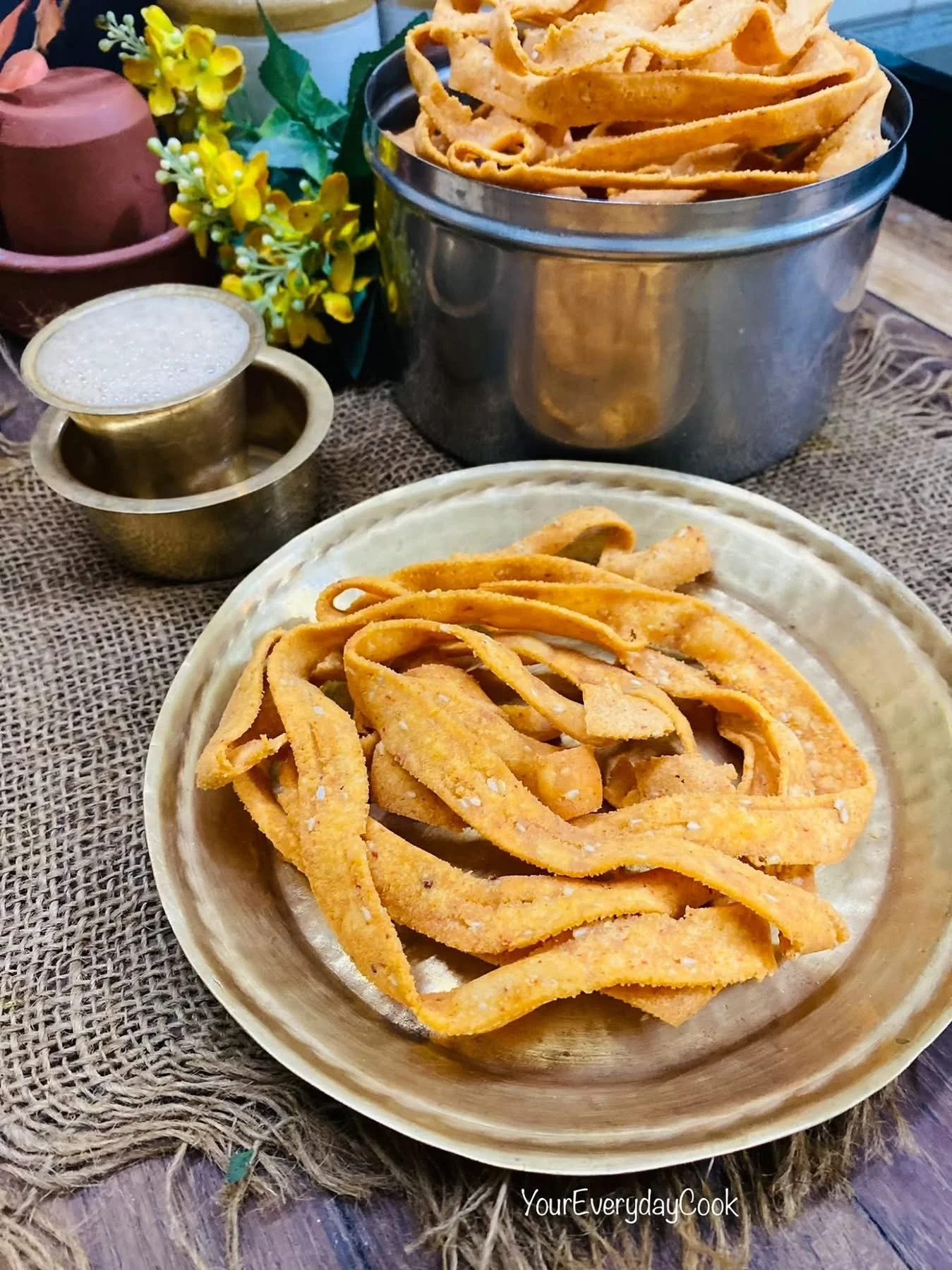
Ribbon Pakoda (Nada Pakoda)
Crisp, golden ribbons made with rice flour and besan, pressed straight into hot oil.
Ingredients
4 cups rice flour (fresh, store-bought is fine)
2 cups besan (gram flour)
1/2 tsp asafoetida powder
1 1/2 tsp chilli powder (adjust to taste)
1 tsp white sesame seeds
Salt to taste
2 tbsp hot melted ghee, or butter at room temperature (hot oil also works; butter tastes best)
Oil for deep frying
Method
Sieve both flours. Add the asafoetida, chilli powder, sesame seeds and salt. Add the hot ghee, butter or oil and rub it in by hand until the flour is crumbly and evenly coated.
Add water a little at a time and make a soft dough, not too soft and not too tight.
Fit the ribbon plate (the one with two slits) into the murukku press. Grease it if needed and fill it with a ball of dough.
Heat the oil. It's ready when a small bit of dough rises up sizzling. Press the ribbons straight into the oil in a circle or any shape.
Fry on medium heat, turning to cook all sides, until firm and brown and the sizzling stops. Drain, cool, and check the taste and crunch.
Tip: You can fix the dough even after it's made, so keep a little flour aside. For the first time, start with a small batch (2 cups of rice flour and the rest in proportion).
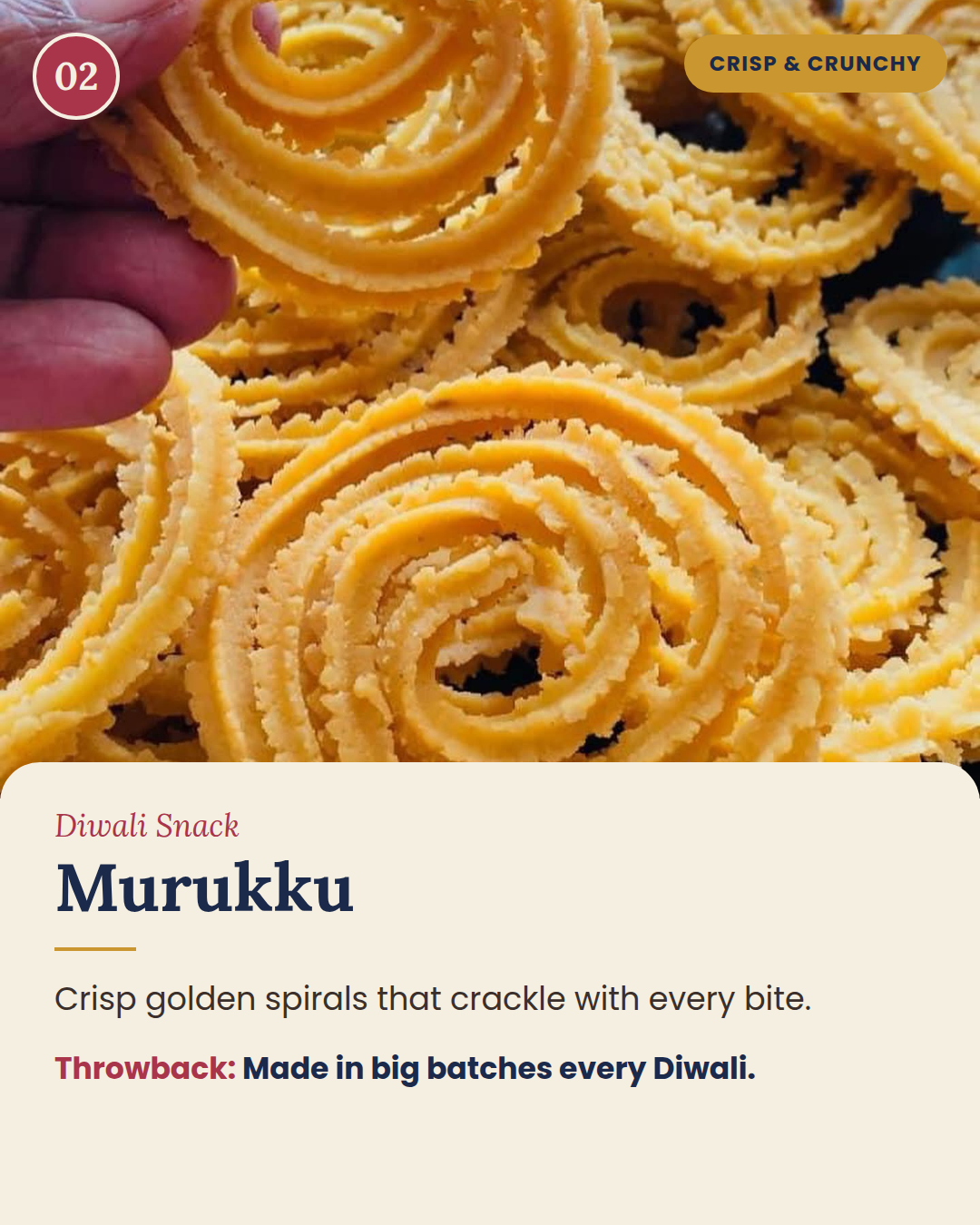
Besan Murukku
Crisp spiral murukku made with rice flour and besan, spiced with ajwain.
Ingredients
1 cup rice flour
1/2 cup besan (gram flour)
1 tsp chilli powder (or as you like)
1/4 tsp crushed ajwain
Pinch of turmeric powder
Pinch of asafoetida powder
Salt as required
1 1/2 tbsp butter, or 3 tbsp hot oil
Oil for deep frying
Method
Mix the two flours well. Add the butter (or hot oil) and rub it in until the flour is crumbly.
Add the ajwain, chilli powder, turmeric, asafoetida and salt. Add water slowly and make a smooth, firm dough.
Fill a murukku press with the dough and shape round murukku. You can also press the dough into the hot oil as sticks.
Heat the oil. It's ready when a pinch of dough rises immediately, sizzling. Then reduce the flame to medium.
Press the murukku into the oil and cook both sides until done. They turn crisp as they cool.
Tip: Don't judge the crispness straight from the oil. Let them cool before you check.
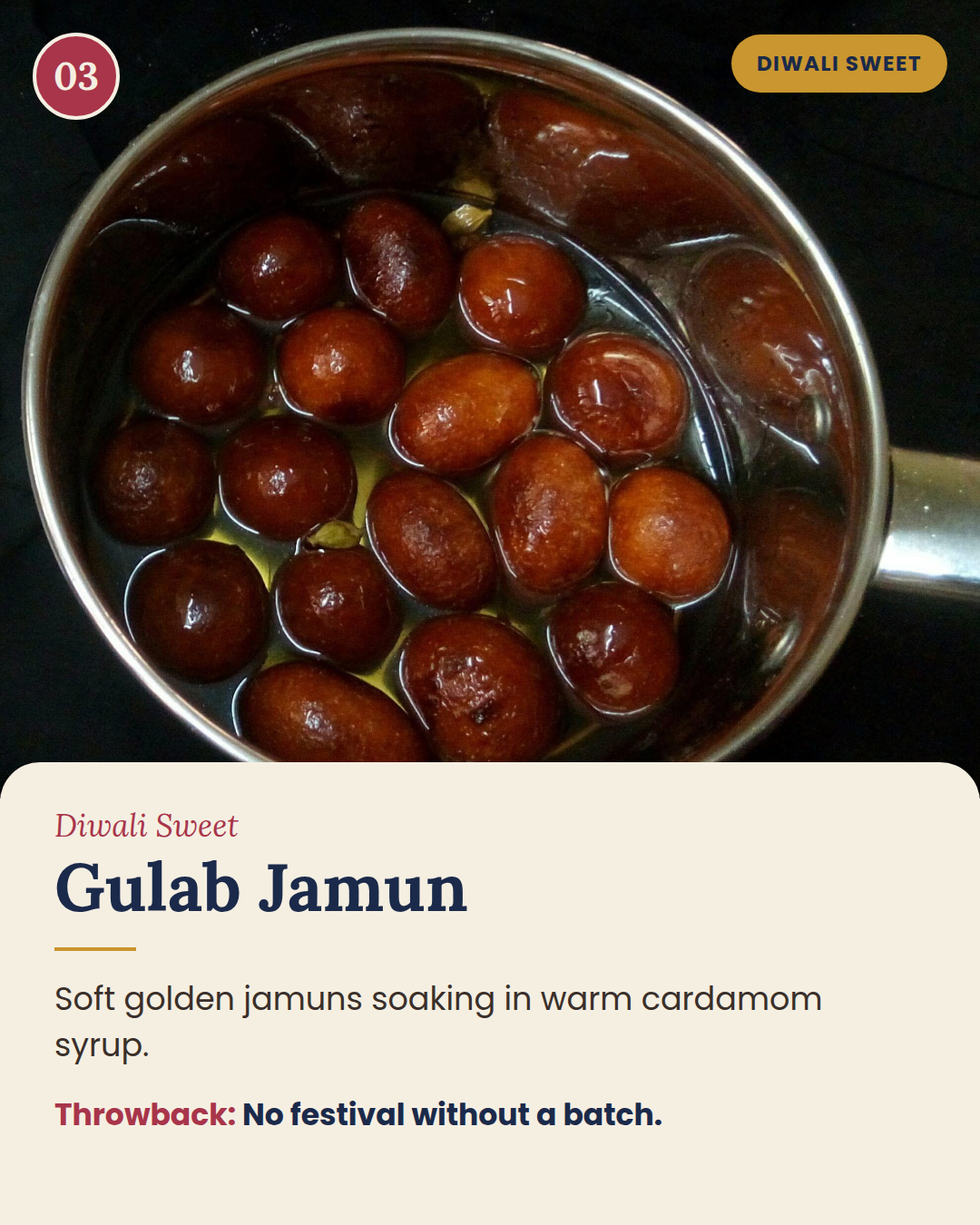
Khoa Gulab Jamun
Soft, deep-reddish jamuns made with homemade khoa and soaked in a lightly sticky cardamom syrup. Makes about 21 medium jamuns.
Ingredients
1 cup finely crumbled khoa/mava (homemade instant khoa works)
4 tbsp all-purpose flour (maida)
1/4 tsp baking soda
A little ghee, only if needed for the dough
Oil for deep frying
For the syrup
2 1/2 cups sugar
1 1/4 cups water
Pinch of green cardamom powder
Saffron strands (for garnish)
Pistachio flakes to garnish (optional)
Method
Mix the crumbled khoa, maida and baking soda. Add a very little water at a time and make a smooth, firm dough, using a little ghee if needed. Don't knead. Rest it for 10 minutes.
Boil the sugar and water, removing any scum. Add the cardamom and let the syrup thicken very lightly, so it's sticky to the touch and just begins to form a thin string. Don't make a string-consistency syrup. Take it off the heat and let it cool a little.
Make small smooth balls. Heat the oil to medium and drop them in carefully from the side, without crowding the pan.
Keep turning them gently with a ladle so they don't stick and cook evenly. They look soft in the oil but turn firm as they cool. Take them out as soon as they darken to a deep reddish colour, and drain on a paper towel.
Drop them into the syrup once it's only slightly warm, not boiling hot. Let them soak for a while. Serve warm or chilled, garnished with pistachio flakes and saffron.
Tip: Don't crowd the pan, and don't let the syrup be boiling hot when the jamuns go in.
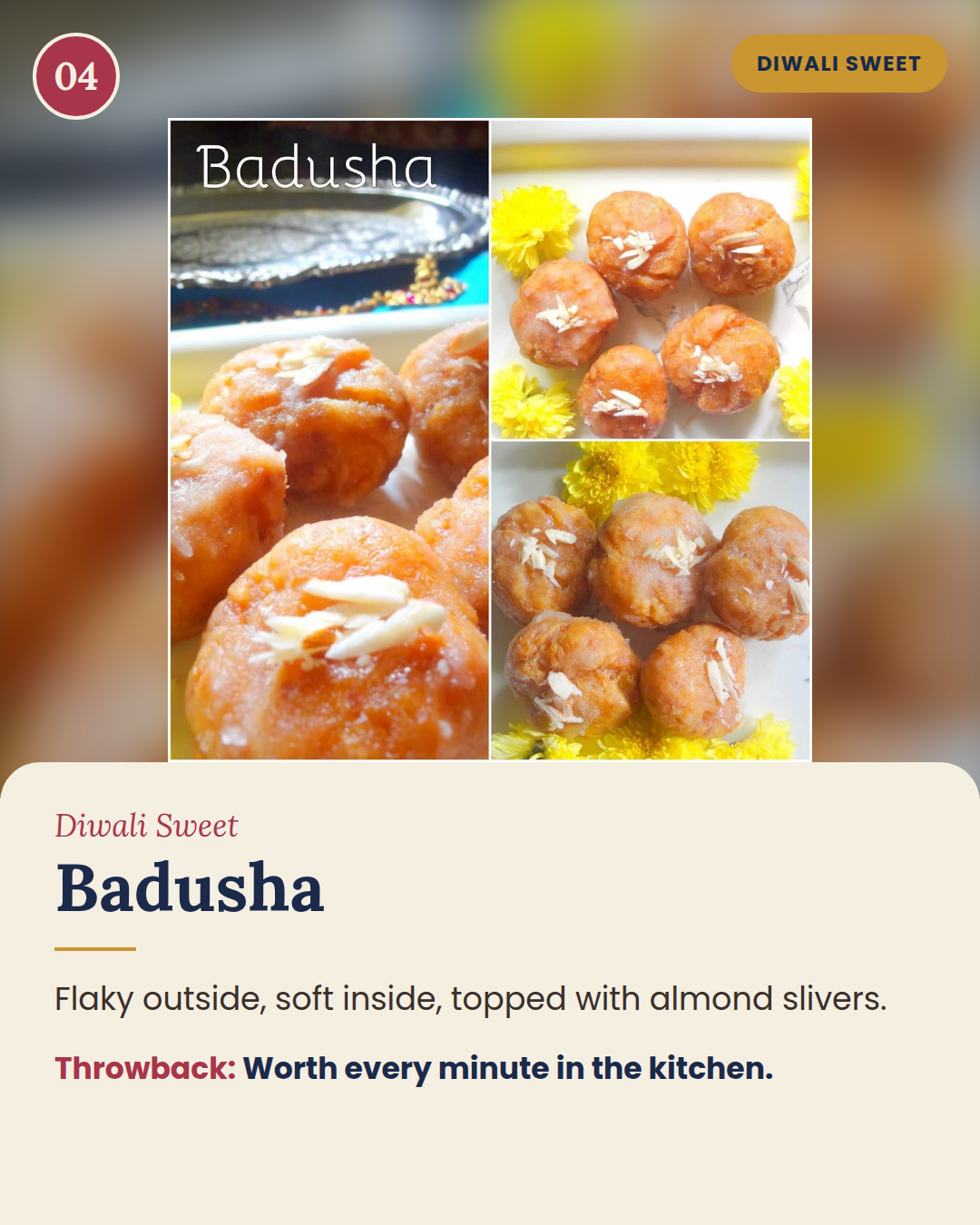
INGREDIENTS:
1 cup all purpose flour ( maida)
1/4 cup curd
1 tbsp heaped butter ( chilled)
A pinch of baking soda
1/2 tsp baking powder
Saffron strands
1 cup sugar for syrup
water just enough to immerse the sugar
Pinch of green cardamom powder
some pistachio flakes or almond flakes for garnishing
Oil for deep frying.
PREPARATION METHOD:
Take a bowl, add the dry ingredients , maida, baking powder, soda , mix well,or better sieve it .
To that add the chilled butter and mix them together till you get a bread crumb like texture. Mix with fingers till the dry ingredients are coated well and appear crumbly.Next add curd and mix lightly , not kneading them too much as you need the dough to be light , so just bring the dough together by adding little drops of water till you get a non sticky light dough.
Cover and keep for 20 minutes.In the meanwhile keep your sugar syrup ready. Take a pan ,add the sugar and water just enough to immerse the sugar, add the lime juice. clear out scum if any, then add the cardamom powder, saffron threads.
The sugar syrup should be of almost one string consistency or if you want the crystallized effect, make it nearly 2 string consistency.. Your badushas will get the white crystallized sugar coating on top. after it is cooled. You can see such badushas in the shops.
Now keep a pan with oil to heat on avery low flame , the oil must be just about warm when you slide the badushas for frying. , test with one badusha , it must start making small bubbles while in the bottom of the pan , that is the right temperature , so slide in all badushas or as much can filt in the kadai, and when you slide them ,they will seem to settle in the bottom , dont worry , as the oil gets heated, they will rise and come up light and bigger, then you must slightly increase the flame to continue the frying .
You will notice after 20 minutes the dough would have become lighter and when you pull apart the dough with fingers you will see the rough texture inside just like bread dough after it has risen.
Pinch off small balls and dont press them too hard or roll too smooth like the chapati dough, just a rough ball , make a dent in centre with the thumb, make all the badushas this way.If you have the time and patience do the fancy crimping like we do for the karchikais. by twisting and turning the ends of the badusha. I kept them simple doughnut style
Check to see if oil is warm enough, drop a small ball of dough , test with one badusha , it must start making small bubbles while in the bottom of the pan , that is the right temperature , so slide in all badushas or as much can filt in the kadai, and when you slide them ,they will seem to settle in the bottom , dont worry , as the oil gets heated, they will rise and come up light and bigger, then you must slightly increase the flame to continue the frying .
Let them cook on a medium to slow flame as they need to cook well inside too, it will take time so patience is the key .
when they turn golden and look crispy with the flakes showing, time to remove , drain on a paper towel.Let these fried badushas cool a bit and then drop into the warm sugar syrup for 210 minutes .
Take them out and keep aside. After cooling you will see the badushas look shiny and sugar coated., as w ell as syrup has been absorbed by badusha .For a more powdery sugar coated effect, dip them once more and take out to cool.You will get the white crystallized effect .
When you bite into the badusha, you will see them flaky inside.
That s the correct texture..Enjoy Diwali by making a traditional sweet .
Take them out to cool. For the powdery white coating, dip them once more.
Tip: Patience is the secret. Keep the heat low so they cook through and turn flaky inside.
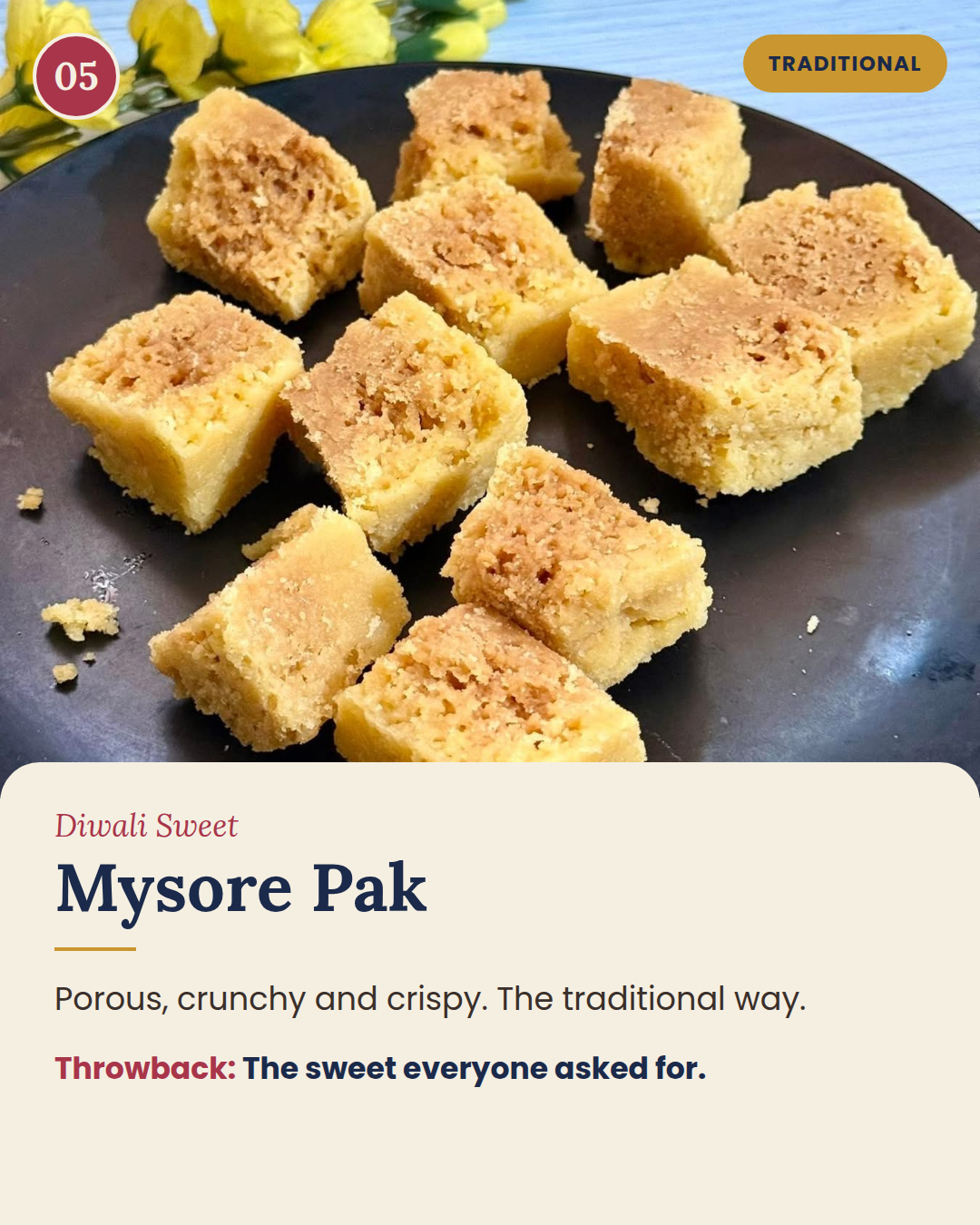
Mysore Pak
A traditional porous, crunchy, crisp Mysore pak, made with besan, hot ghee and oil.
Ingredients
1 cup besan (gram flour), sieved
1 and 1/2 cup sugar (add more for a sweeter Mysore pak)
1 cup ghee
1/4 cup oil
1/2 cup water or just enough to cover the dust in the pan
1 to 2 tbsp milk (to lift the scum from the syrup)
Method
Grease a deep tray and keep it ready. Sieve the besan well.
Heat the ghee and oil together in a saucepan on another burner. Keep it hot on a very low flame the whole time.
In a heavy-bottomed pan, melt the sugar with the water. Add the milk and scoop out the scum.
Boil the syrup until frothy and 1-string consistency, sticky between finger and thumb.
Switch off the flame, or keep it very low. Add the besan with one hand while stirring with the other, quickly. Then switch the flame on and keep stirring until there are no lumps.
Add the hot ghee and oil mixture one ladle at a time. It should sizzle. Add the next ladle only after the mixture has absorbed the last one and looks like halwa.
Keep going. The mixture thickens and turns frothy at the sides, and in the last stage it looks like over-fermented idli batter. When it stops absorbing the ghee and starts releasing it at the sides, pour it quickly into the tray.
Don't level the top or tilt the tray. Pat it gently with a flat spatula or tap the tray.
Before it dries completely, score light knife marks for the pieces, without cutting through.
After an hour, turn the tray upside down onto a plate. The slab comes out and the pieces separate easily.
Tip: A deep aluminium tray, like the sweet shops use, keeps the heat in and gives the dark centre and porous top.
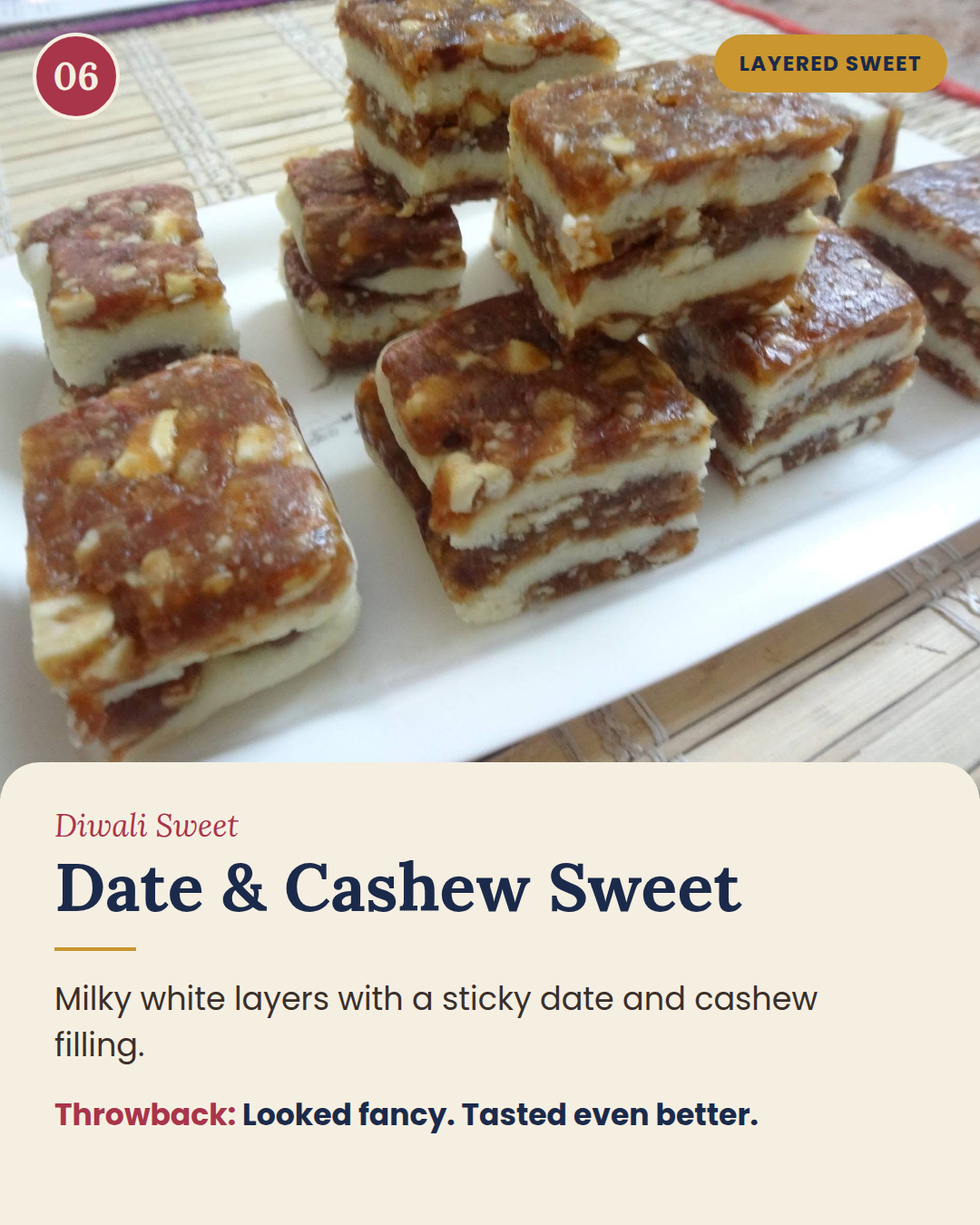
Date and Cashew Layered Sweet
Milky white layers with a soft, sticky date and cashew filling. Makes 16 to 20 pieces. Prep 20 min, cook 15 min, chill 1 to 2 hours.
Ingredients
White layer
1 cup milk powder
1/2 cup cashew powder
1/4 cup powdered sugar
2 tbsp ghee
3 to 5 tbsp milk
1/4 tsp cardamom powder
Date and cashew layer
1 cup (200 g) pitted dates
1/2 cup chopped cashews
1/4 cup cashew powder
1 tsp ghee
1/4 tsp cardamom powder
1 to 2 tsp warm water, if needed
Method
Date layer: Heat 1 tsp ghee and cook the chopped dates on low heat for 3 to 5 minutes until soft, adding a little warm water if needed. Mix in the chopped cashews, cashew powder and cardamom. Cook until thick and sticky.
White layer: Mix the milk powder, cashew powder, sugar, cardamom and 2 tbsp ghee. Add the milk gradually to make a soft dough. Cook on low heat for 3 to 5 minutes, stirring, until it comes together.
Layer: Grease and line a 6 x 6-inch tray. Press half the white mixture into the tray and spread half the date filling over it. Repeat with the rest of both.
Set and cut: Press gently to compact the layers. Cool, refrigerate for 1 to 2 hours, then cut into neat squares.
Tip: Chilling is what makes the layers firm enough to cut cleanly. Store in an airtight container in the fridge for 5 to 7 days.
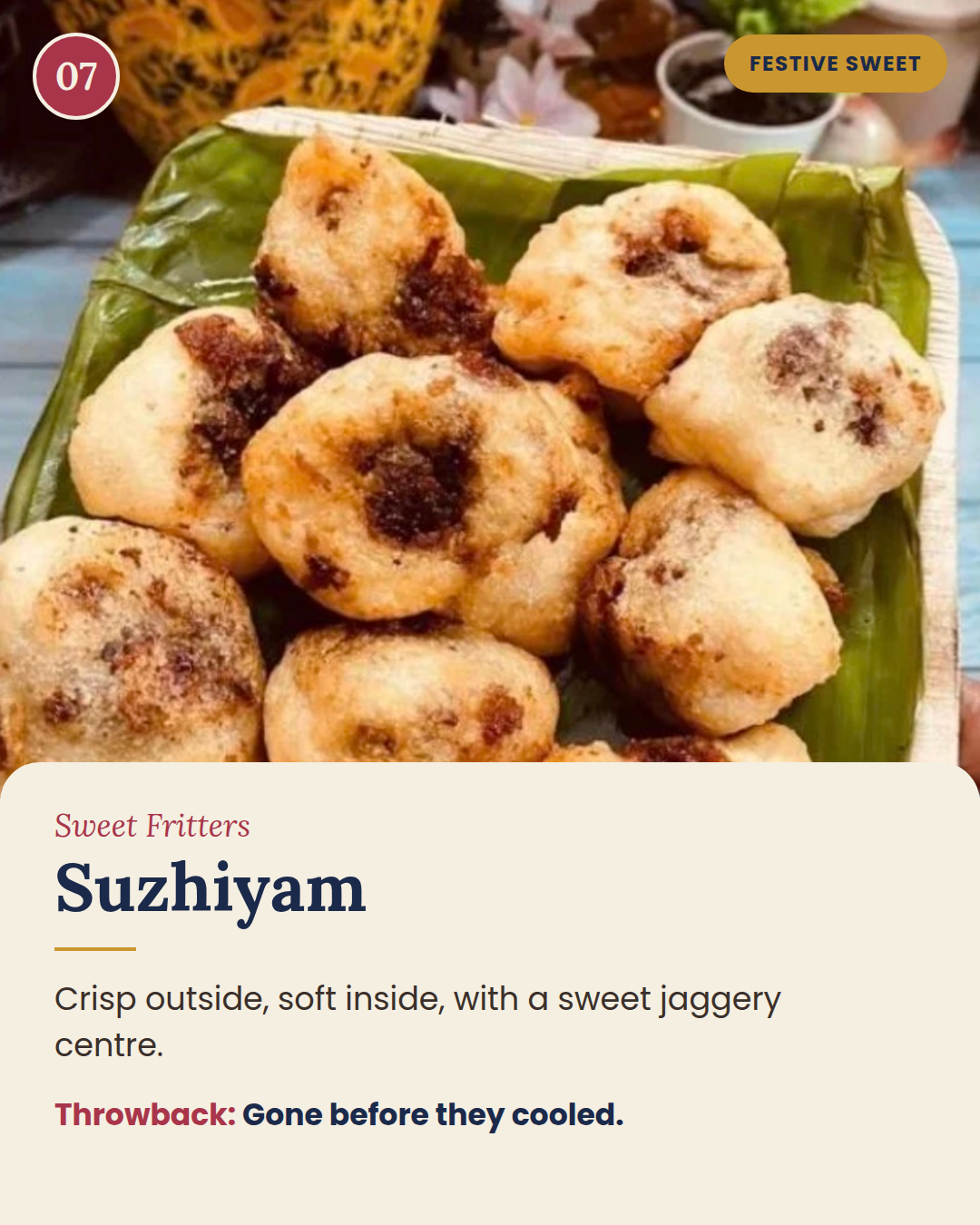
Suzhiyam
A traditional Tamil sweet: balls of chana dal, jaggery and coconut filling, dipped in a rice and urad dal batter and fried golden.
Ingredients
Outer batter
1 cup raw rice
1/4 cup urad dal
Pinch of salt
Water as needed
Filling
1 cup chana dal (kadalai paruppu)
3/4 to 1 cup jaggery
1/2 cup grated coconut
1/2 to 1 tsp cardamom powder
Oil for deep frying
Method
Soak the rice and urad dal for 3 to 4 hours. Grind to a smooth, thick batter with a little salt.
Cook the chana dal until soft but not mushy. Drain well and mash.
Cook the jaggery with a little water and strain if needed. Mix it with the dal, coconut and cardamom.
Cook the filling until it's firm enough to shape. Cool, then roll into small balls.
Dip each ball in the batter and deep-fry on medium heat until golden brown.
Tip: Drain the cooked dal thoroughly. Extra water makes the filling too soft to shape.
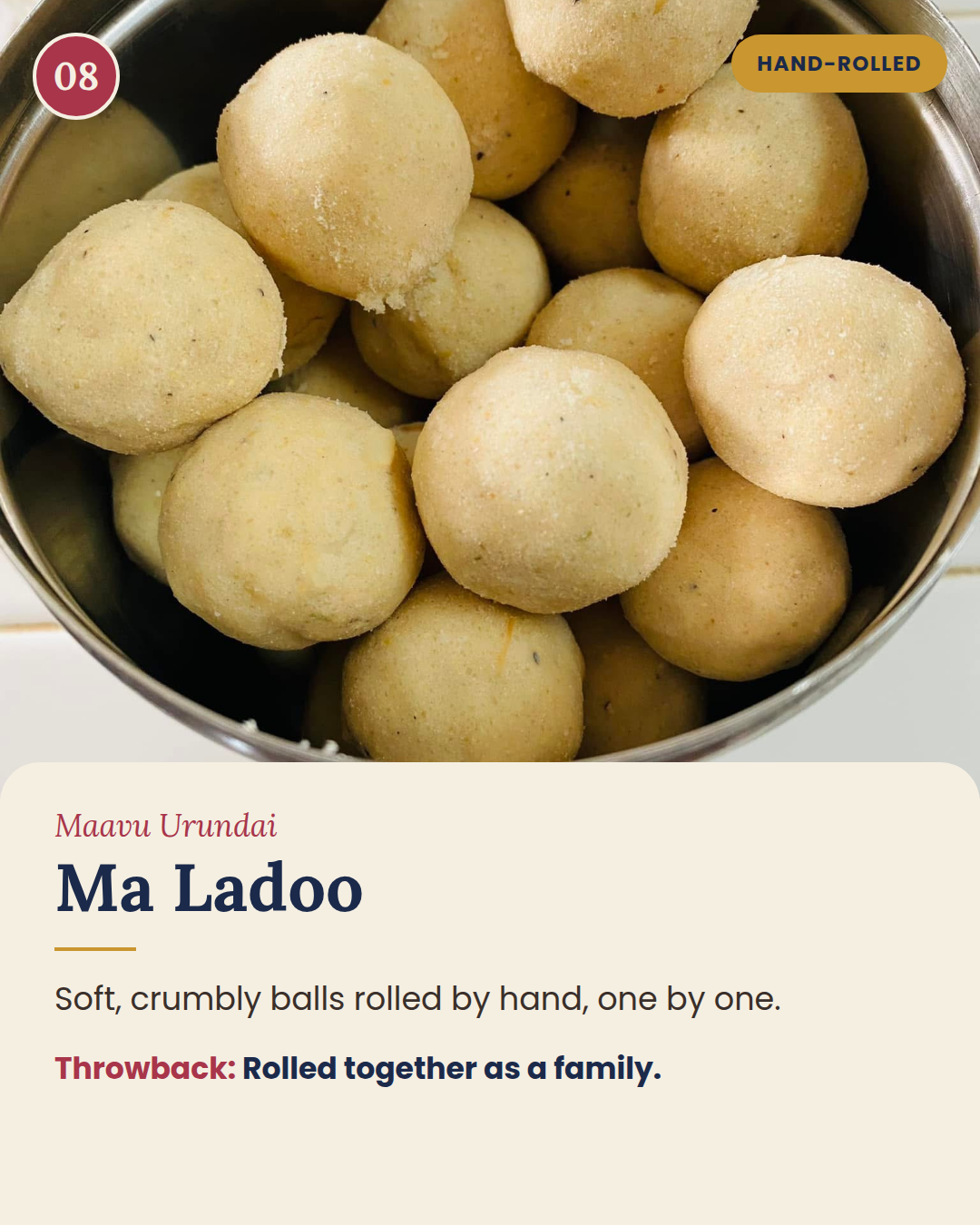
A classic South Indian sweet made with roasted gram flour, powdered sugar, and ghee. It’s quick, melts in your mouth, and is especially popular during Diwali.
Prep time
10 minutes
Makes
12–15 ladoos
Ingredients
1 cup pottukadalai (roasted gram / roasted chana dal)
½ cup powdered sugar
¼ cup ghee, melted (add gradually as needed)
¼ teaspoon cardamom powder
2 tablespoons cashews, chopped (optional)
Method
Powder the roasted gram: Grind the pottukadalai into a fine powder. Sieve to remove coarse pieces.
Prepare the sugar: Powder the sugar and mix it with the gram flour and cardamom.
Add cashews: If using, fry the cashews in a little ghee until lightly golden.
Mix in ghee: Warm the ghee until melted but not smoking. Add it gradually to the flour mixture, mixing thoroughly until it resembles damp sand and holds together when pressed.
Shape the ladoos: While the mixture is still warm, take small portions and press firmly between your palms to form round balls.
Cool and store: Let the ladoos cool completely before storing in an airtight container.
Tips for soft, melt-in-the-mouth Maa Ladoo
Grind the roasted gram very finely for a smooth texture.
Add ghee gradually; too much can make the ladoos greasy.
If the mixture doesn't hold together, add a little more warm ghee.
Don't roast the pottukadalai for too long, as it is already roasted.
Storage: Keeps for about 1–2 weeks in an airtight container at room temperature, in a cool, dry place.
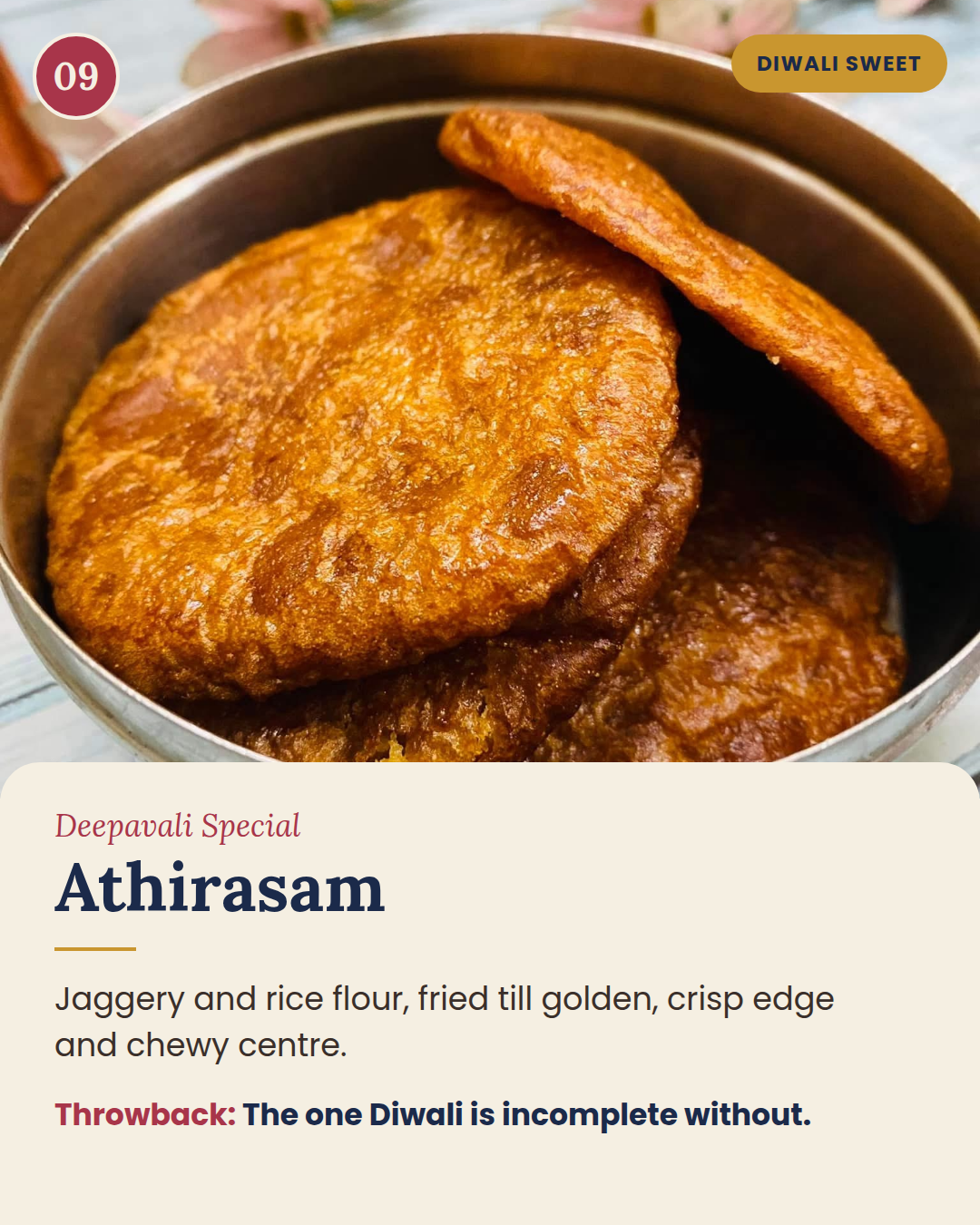
Ingredients
• For the flour: 1 cup raw rice
• For the syrup: 3/4 cup jaggery, plus a little water to melt
• Flavoring: Ginger powder and cardamom powder
• To finish: 1 tsp ghee, oil for deep frying, banana leaf for shaping
Method
• Prepare the rice: Wash 1 cup raw rice, soak for 1 hour, drain. Spread on a cloth to dry until just damp, then grind to a fine powder. Sieve it once more to get fine powder . Slightly coarse is also fine . Keep the rice flour covered with a damp cloth to keep it moist and prevent drying .
• Make the syrup: Melt 3/4 cup jaggery with a little water, strain to remove impurities, then boil in a kadai till it reaches thakkali padam, the soft ball stage. When you drop a little in water, it should form a soft ball that flattens on pressing.
• Make the dough: Add the rice flour to the hot syrup in batches and mix quickly. Add ginger powder and cardamom powder and mix to a thick, soft dough.
• Rest the dough: Transfer to a bowl, cover the top with 1 tsp ghee, and allow to rest until cool enough to handle. Usually this dough is allowed to rest overnight for better flavour and also easy to handle . The dough will firm up well after overnight or after 4 hours of resting .
• Shape: Take a small ball, place on an oiled banana leaf, and pat with oiled fingers into a thin round disc, about 1/4 inch thick.
• Fry: Slide into medium hot oil. Fry on medium heat, flipping once, until deep golden brown. Press lightly with a slotted spoon while frying.
• Drain: Lift out and press lightly with a small bowl to remove excess oil.
Serve warm on a banana leaf. The key is the syrup stage and keeping the disc thin, so it turns crisp outside and stays soft inside.
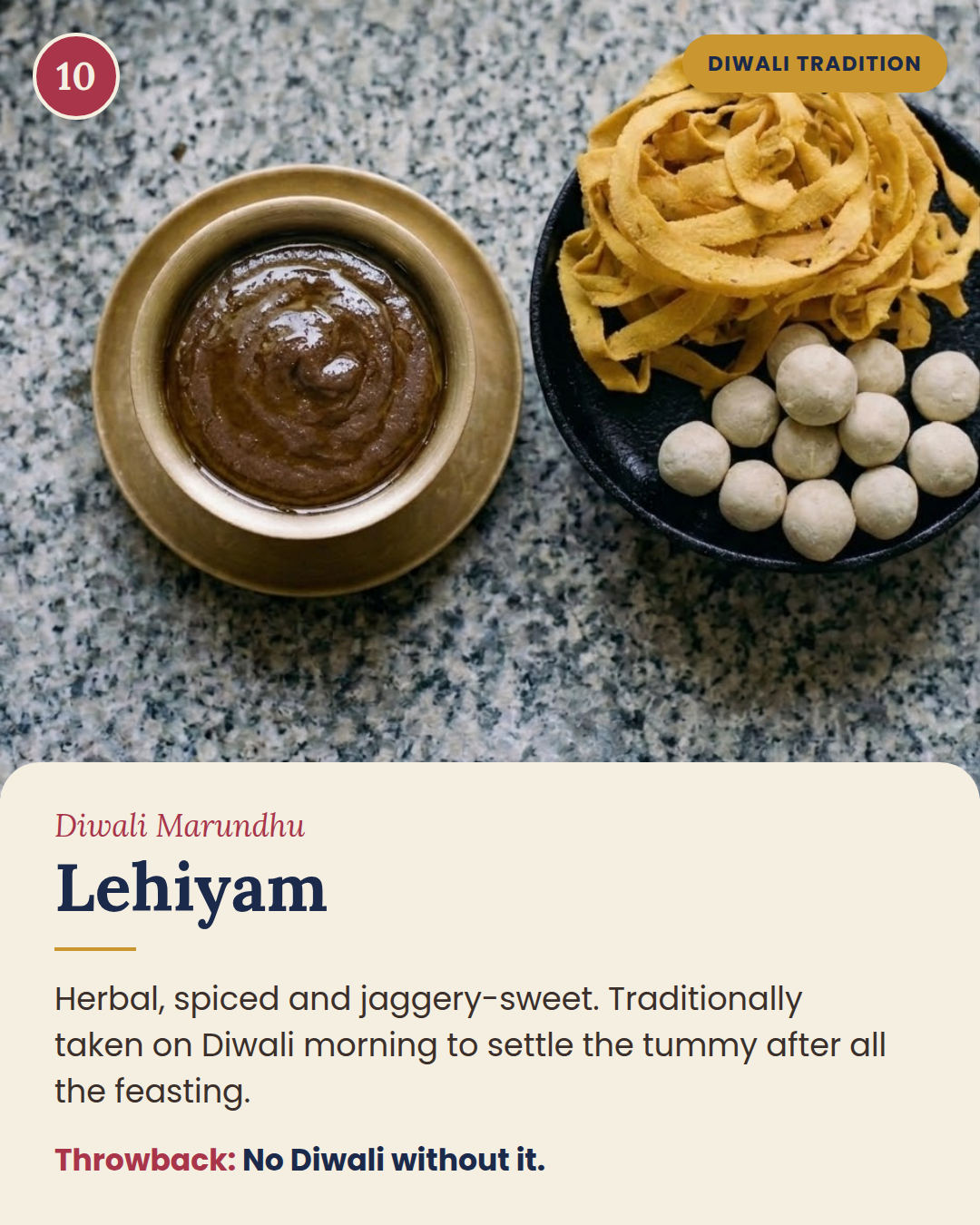
Deepavali Lehiyam
This is the traditional lehiyam made for Deepavali morning, after the oil bath and before the sweets and savouries. It is warming, digestive, and meant to be taken in a small spoonful, not eaten like a sweet.
Ingredients
For the lehiyam powder:
• Dry ginger (chukku), 25 gms
• Thyme, 2 tsp
• Cinnamon, 3 to 4 sticks
• Poppy seeds, 2 tsp
• Soambu (fennel seeds), 2 tsp
• Pepper, 1 tbl.sp.
• Cumin seeds, 1 tbl.sp.
For the lehiyam base:
• Ginger, 50 gms
• Lime, 1
• Tomato, 1 big
• Ghee, 2 tbl.sp.
• Gingelly oil (sesame oil), 2 tbl.sp.
• Honey, 1 tbl.sp.
• Jaggery, 150 gms
Method
• Make the powder: Dry the above powder ingredients separately and fry them separately without oil, until dark brown. Cool completely and grind to a smooth powder. Keep aside.
• Extract the juices: Wash the fresh ginger, grind with a little water, and extract the juice. Extract lime juice and filter it. Extract tomato juice.
• Make the syrup: Add all three juices to the jaggery and keep on a slow fire. When the jaggery dissolves, filter to remove the dust. Put it back on a slow fire and cook until a thick syrup forms.
• Finish the lehiyam: Sprinkle in the lehiyam powder and stir well. Add ghee and gingelly oil. Keep stirring until the mixture turns non sticky and leaves the sides of the pan.
• Add honey: Remove from the fire, add honey, and mix well. Let it cool completely.
• Store: Store in a clean and dry container.
There are many more recipes in the blog . Do look for them or message me for quick responses. Happy Diwali 🪔